How to Make an Herbal Decoction
Learn to make herbal decoctions that draw flavor and plant compounds out of roots, bark, and seeds by gently simmering them, using equipment you already have.
How to Make an Herbal Decoction
Quick Recipe Card
| Type | Decoction (Water Extraction) |
|---|---|
| Best For | Roots, bark, seeds, berries |
| Time Required | 10–15 min simmer + cooling time |
| Yield | About 2 cups (serves 4) |
| Shelf Life | 24–48 hours refrigerated (our advice; see Storage) |
| Storage | Glass jar in refrigerator |
What You’ll Learn
A decoction draws out the goodness from tougher plant materials—roots, bark, seeds, or berries—by gently simmering them in water. Think of it as making a strong herbal broth. If you can simmer soup, you can make a decoction.
Materials & Equipment
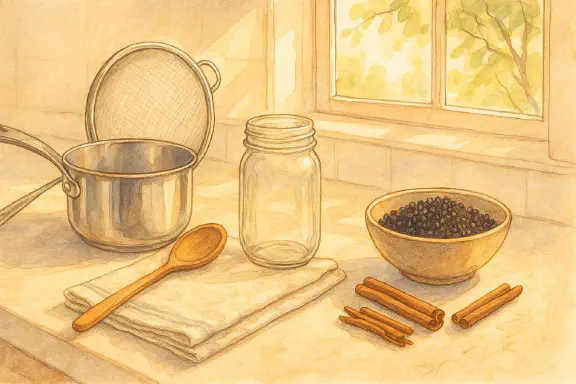
Ingredients
- Dried herbs: 1 tablespoon per cup of water (see our herb drying guide)
- Fresh herbs: 2 tablespoons per cup of water
- Water: Fresh, preferably filtered
Kitchen Tools
- Small saucepan (2–3 quart, stainless steel or enamel—avoid aluminum)
- Fine mesh strainer or cheesecloth ad
- Wooden spoon ad
- Glass jar ad for storage
- Kitchen towel ad for handling
Helpful but optional: A saucepan with a pour spout ad makes straining easier. Consider getting a dedicated herb pot if you’ll be doing this regularly.
Step-by-Step Instructions
1. Measure Your Herbs
Place herbs in your saucepan. For a family batch:
- Dried: 2–3 tablespoons total (small handful)
- Fresh: 4–6 tablespoons total (double handful)
Visual cue: If using roots or bark, break into smaller pieces first—about the size of your pinky fingernail.
2. Add Cold Water
Pour cold water over herbs until it sits about 2 inches above them. This usually means:
- 3 cups water for a 2-cup finished decoction
- 4 cups water for a 3-cup finished decoction
Why cold? Starting cold lets the plant materials gradually open up and release their goodness.
3. Bring to a Gentle Boil
Set pot on medium heat. Watch for the first bubbles, then immediately reduce to low. You want a gentle simmer, not a rolling boil.
4. Simmer Covered
Put the lid on. Let simmer:
- Most roots and bark: 10–15 minutes
- Tougher roots (burdock, astragalus): 20–30 minutes
- Seeds and berries: 15–20 minutes
You’ll see slow, steady bubbles—like a lazy hot spring, not a jacuzzi.
5. Cool and Strain
Remove from heat. Let cool 5 minutes, then strain through your mesh strainer into a clean jar. Press the herbs with the back of a spoon to get every drop.
Hot water and drinks can cause serious scald burns in young children; keep hot drinks away from table and counter edges (American Burn Association). Our advice: treat the pot and the hot jar the same way (safety notes).
It’s ready when the liquid is richly colored and aromatic.
6. Store or Serve
Label with date and contents. Refrigerate immediately if not using. Serve warm.
Start with a small serving to check for reactions. If you’re pregnant, nursing, take medicine or have a health condition, talk to your doctor or pharmacist first, and check the herb’s own page for its cautions (safety notes).
Fresh vs. Dried: What’s the Difference?
Dried herbs are concentrated, so you need less. They’re available year-round and easy to store. See our guide to drying herbs.
Fresh herbs contain water, so double the amount. They give a brighter taste but need more prep (washing, chopping). Great when your garden’s producing!
Quick conversion: If a recipe calls for 1 tablespoon dried, use 2 tablespoons fresh.
Storage & Shelf Life
- Refrigerate in a sealed glass jar
- Use within 24–48 hours: Our advice. None of our sources gives a refrigerated shelf life for decoctions.
- Don’t leave it out: For brewed tea, Iowa State Extension says, “Brewed tea should not be held at room temperature for more than 8 hours” (Iowa State Extension); Illinois Extension gives the same 8-hour limit for brewed tea (Illinois Extension). Our advice: treat a decoction the same way.
- Discard if: Cloudy, fizzy, or sour-smelling
- Reheating: Warm gently on the stove (not microwave)
Make small batches—it’s better to brew fresh than risk spoilage.
Safety Notes
- Never use aluminum pots (can react with herbs)
- Start with small servings to check for reactions
- Some herbs need specific dosing—research before using medicinally
- Keep labeled and away from children
- If you’re pregnant, nursing, take medicine or have a health condition, talk to your doctor or pharmacist first
- Hot liquids: The American Burn Association says, “Young children’s skin burns more quickly and deeply than adults’. Hot water, drinks, and kitchen items can cause serious scald burns,” and advises, “Keep hot drinks away from the table and counter edges” (American Burn Association).
- Elderberries: Raw or unripe elderberries and other parts of the elder tree, such as the leaves and stem, contain cyanide-producing substances that can cause nausea, vomiting and severe diarrhea; cooking eliminates this toxin (NCCIH). See the elderberry safety notes.
- Honey: “Do not feed honey to a child who is younger than 1 year old” (CDC).
- Fennel seed: EMA’s monographs on sweet and bitter fennel fruit, which cover fennel tea as a traditional herbal medicine, say safety during pregnancy and lactation “has not been established” and “In the absence of sufficient data, the use during pregnancy and lactation is not recommended.” They add that “The use is not recommended in children under 4 years of age,” for lack of adequate data (EMA, sweet fennel; EMA, bitter fennel).
- Herb-specific cautions: Each plant page has its own safety notes; read them before you use that herb.
Example Recipes
Elderberry, Cinnamon & Ginger Decoction
Makes about 2 cups
Ingredients:
- 2 tbsp dried elderberries
- 1 cinnamon stick (3 inches)
- 1 tsp dried ginger root
- 3 cups water
Instructions: Combine all ingredients in a saucepan. Bring to a boil, reduce the heat, and simmer covered for 20 minutes. Follow this cooking step all the way through; don’t skip it or cut it short. Our advice: the 20 minutes is a flavor step, not a safety minimum. Strain and sweeten with honey if desired. Never give honey to a child under 1 year old (CDC; safety notes).
Elderberry caution: Never use elderberries raw or unripe, and keep leaves, stems, bark and roots out of the pot (bark and roots: see Can you eat raw or dried elderberries?, which cite MSKCC and NC State). Raw or unripe berries, leaves and stems contain cyanide-producing substances, and cooking eliminates the toxin (NCCIH; safety notes). Pregnant, breastfeeding, on medicine, or giving it to a child? Read the elderberry safety notes first.
None of our sources sets a general minimum cooking time; University of Maine Extension’s advice is to “follow any heating instructions contained in a recipe.” For a sourced elderberry method, use our elderberry syrup recipe, adapted from UMaine, which simmers the berries until the liquid is reduced by about half; its safety notes cover leaves, stems, pregnancy, children and medicines. Growing your own? See how to grow and harvest elderberry safely.
Dandelion & Burdock Root Blend
Makes about 2 cups
Ingredients:
- 1 tbsp dried dandelion root
- 1 tbsp dried burdock root
- ½ tsp fennel seeds
- 3 cups water
Instructions: Simmer all ingredients covered for 15 minutes. Let cool 10 minutes before straining. Enjoy a cup warm.
Dandelion in theory may interact with diabetes medicines, blood thinners and water pills (NCCIH). Ask your pharmacist if you take any of these. If you’re pregnant, nursing or have a health condition, talk to your doctor or pharmacist first (safety notes).
Fennel caution: EMA’s fennel monographs say safety during pregnancy and lactation “has not been established,” and in the absence of sufficient data, “the use during pregnancy and lactation is not recommended.” They also say, “The use is not recommended in children under 4 years of age,” for lack of adequate data (EMA, sweet fennel; EMA, bitter fennel; safety notes). Our advice: if you’re pregnant or breastfeeding, or making this for a child, leave the fennel out or ask your doctor or pharmacist first.
Licorice-Cinnamon Evening Decoction
Makes about 2 cups
Ingredients:
- 1 tbsp dried licorice root
- ½ tsp cinnamon chips
- 1 tbsp chamomile flowers (for adding after)
- 3 cups water
Instructions: Simmer licorice and cinnamon for 10 minutes. Remove from heat, add chamomile, cover and steep 5 more minutes. Strain and enjoy before bed.
Licorice caution: Skip licorice if you have high blood pressure or heart or kidney problems, if you eat a lot of salt, or if you take corticosteroids. Our advice: skip it if you’re pregnant (NCCIH calls large amounts unsafe in pregnancy). Large amounts or long-term use can cause serious side effects (NCCIH). Chamomile has its own cautions: read the chamomile safety notes before you add it.
Note: The chamomile is added after simmering because delicate flowers are better infused than boiled—see our cold infusion guide for more on that method.
Tips for Success
- Taste as you go: Too strong? Dilute with hot water. Too weak? Simmer a bit longer next time.
- Save those herbs: Many roots can be simmered twice—the second batch will be lighter but still useful.
- Mix it up: Once you’re comfortable, blend different roots and barks to create your own formulas.
- Keep it simple: Don’t overthink measurements. Our ancestors did this by handful and instinct.
When to Choose Decoction Over Other Methods
Use decoction when you have tough, woody plant parts that won’t give up their goodness to a simple steep. For leaves and flowers, see our cold infusion guide. For alcohol-based preparations, check our tincture guide.
Remember: You don’t need fancy equipment or perfect measurements. Just a pot, some herbs, and a little patience. Your great-grandmother probably made decoctions without measuring a thing—and you can too.